
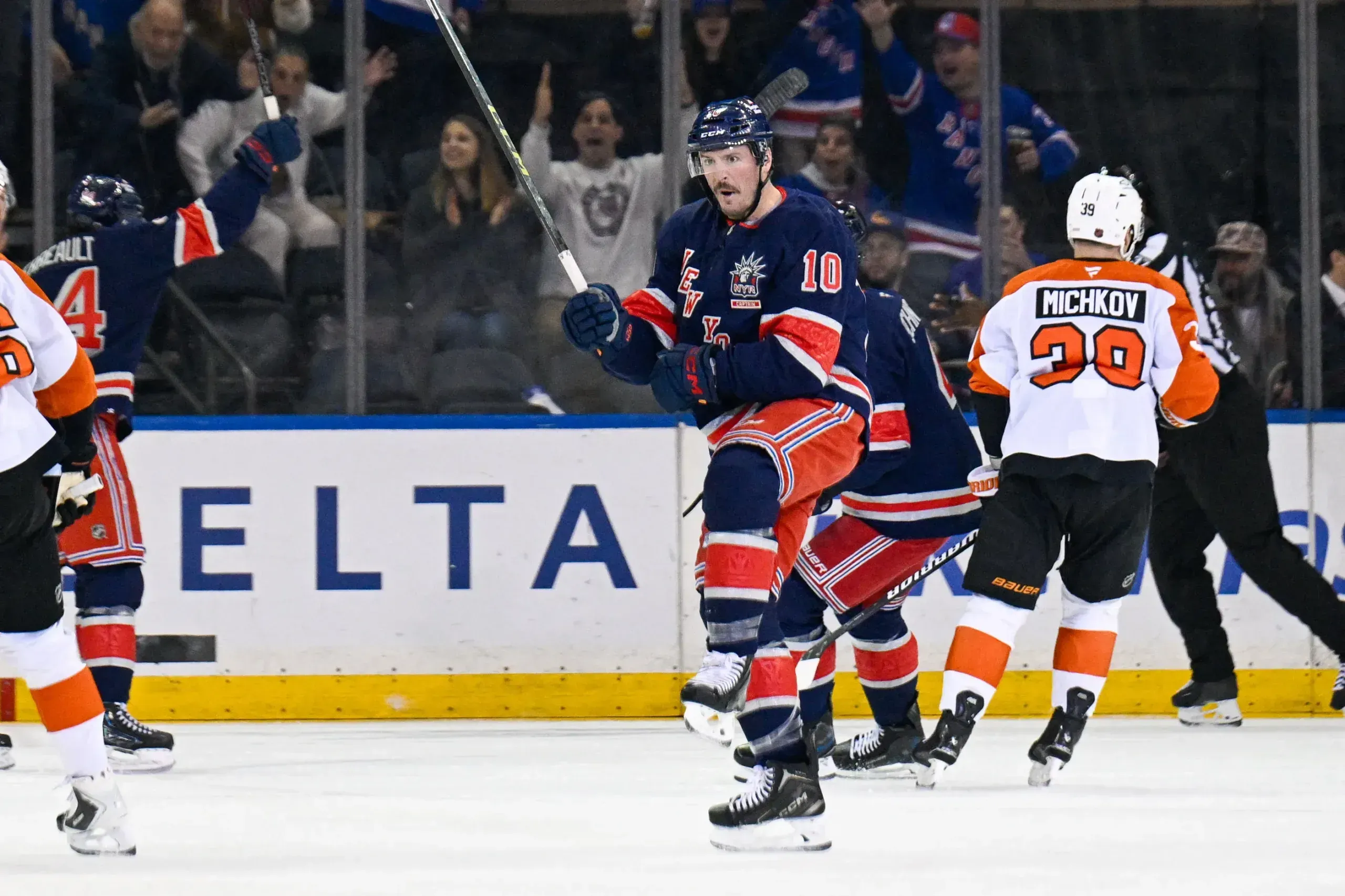
The Flyers have shown much better compete over the past few games. They’ve had stretches where their speed, forecheck and offensive pressure make them look like a completely different team than the one that struggled through the opening weeks of the season.
The problem is that those stretches continue to come in pieces.
Against the New York Rangers, the Flyers once again found themselves in position to walk away with a much-needed victory. Two second-period goals erased a deficit and gave them a 2-1 lead heading into the third period. For 40 minutes, they had done enough to put themselves in control of the game.
Then came the final six minutes.
Whatever momentum the Flyers had built disappeared as the Rangers took advantage of a late power play and a defensive breakdown, turning yet another promising night into another frustrating loss. It was another example of a team that can put together a strong periods but still hasn’t figured out how to carry that same level of play throughout an entire game.
And at this point, that’s becoming one of their biggest problems.
The Flyers aren’t necessarily lacking the ability to play winning hockey. They’ve shown it in stretches. What they haven’t shown is the ability to sustain it, particularly when the circumstances change and they suddenly have something to protect.
Noah Acciari felt that was exactly what happened in the third period.
“We were a little bit more on our heels than we were in the other two periods. I think we were trying to defend a lead rather than just play the game and, you know, kind of do what made us successful during the other periods,” Acciari said.
It’s a familiar problem. Instead of continuing to attack, pressure the puck and play with the same aggressiveness that helped them establish a lead, the Flyers become too concerned with protecting it.
That change in mentality can be difficult to overcome, especially against a team capable of capitalizing on even a brief defensive lapse.
“I don’t know what it was, but we needed to maybe keep the foot on the gas and kind of keep doing what got us there,” Acciari said. “You got to learn from it, and it’s not the way we wanted to start off the road trip.”
The message was pretty straightforward. The Flyers didn’t need to reinvent their game with a one-goal lead. They needed to continue playing the way that got them there.
Rick Tocchet saw the same issue, particularly when it came to defending the middle of the ice.
“When you’re up 2-1, you got to protect the interior of the ice,” Tocchet said. “For whatever reason, when pressure hits us, we forget that you got to protect the interior of the ice. If something bad happens, you give them the outside stuff.”
Tocchet emphasized that defending the middle is fundamental to winning hockey. The Flyers had largely controlled the game for stretches, but when New York made its push, they didn’t respond with the necessary defensive commitment.
Even the penalty situation didn’t change that responsibility.
The bigger concern, however, goes beyond one bad third period or a handful of defensive mistakes. It’s the inability to translate a successful period into another successful period.
The Flyers have repeatedly shown flashes of what it can be, but those flashes haven’t consistently carried over. A strong second period doesn’t guarantee a strong third, and establishing a lead hasn’t meant the Flyers know how to protect it.
Tocchet acknowledged that it takes more than a handful of players to maintain that level.
“Just not enough guys to continue to stack those good shifts together,” Tocchet said. “That’s really what it comes down to. We need more guys. You can’t just rely on four or five. It needs more guys. That’s what our team’s built on. We need the depth of everybody.”
That puts the responsibility on the entire lineup, not just the players expected to provide the offense or the veterans tasked with closing out games.
Travis Sanheim echoed the need for them to clean up the mistakes that continue to give opponents opportunities they haven’t necessarily earned.
“We got to find a way to keep it simple, not turn over pucks and give them chances that they don’t deserve,” Sanheim said. “And we didn’t do that.”
It’s a simple message, but one that the Flyers have struggled to execute consistently. When the pressure increases, the game doesn’t need to become more complicated. Sometimes the best response is the simple play.
Instead, the Flyers continue to give opponents openings.
But this simply isn’t an overnight solution solved by a video session. It will take time and trust that the improvement will come because at this point it has been more of a habit than a lapse of judgment in game.
“We just got to continue to keep working at our game and hope that the process will translate in some success here,” Sanheim said.
That process, though, needs to start producing more than encouraging stretches.
The Flyers are running out of room for moral victories and games where they can point to 40 minutes of good hockey while ignoring what happened in the other 20.
There is enough talent in the room to compete. There have been enough good periods to show that. But until they figure out how to carry their effort, discipline and identity from one period to the next, the same problems will continue to surface.
Against the Rangers, it took just six minutes to erase 40 minutes of progress.
For a team searching for consistency and trying to climb out of an early-season hole, that’s a lesson it can no longer afford to keep learning.
