
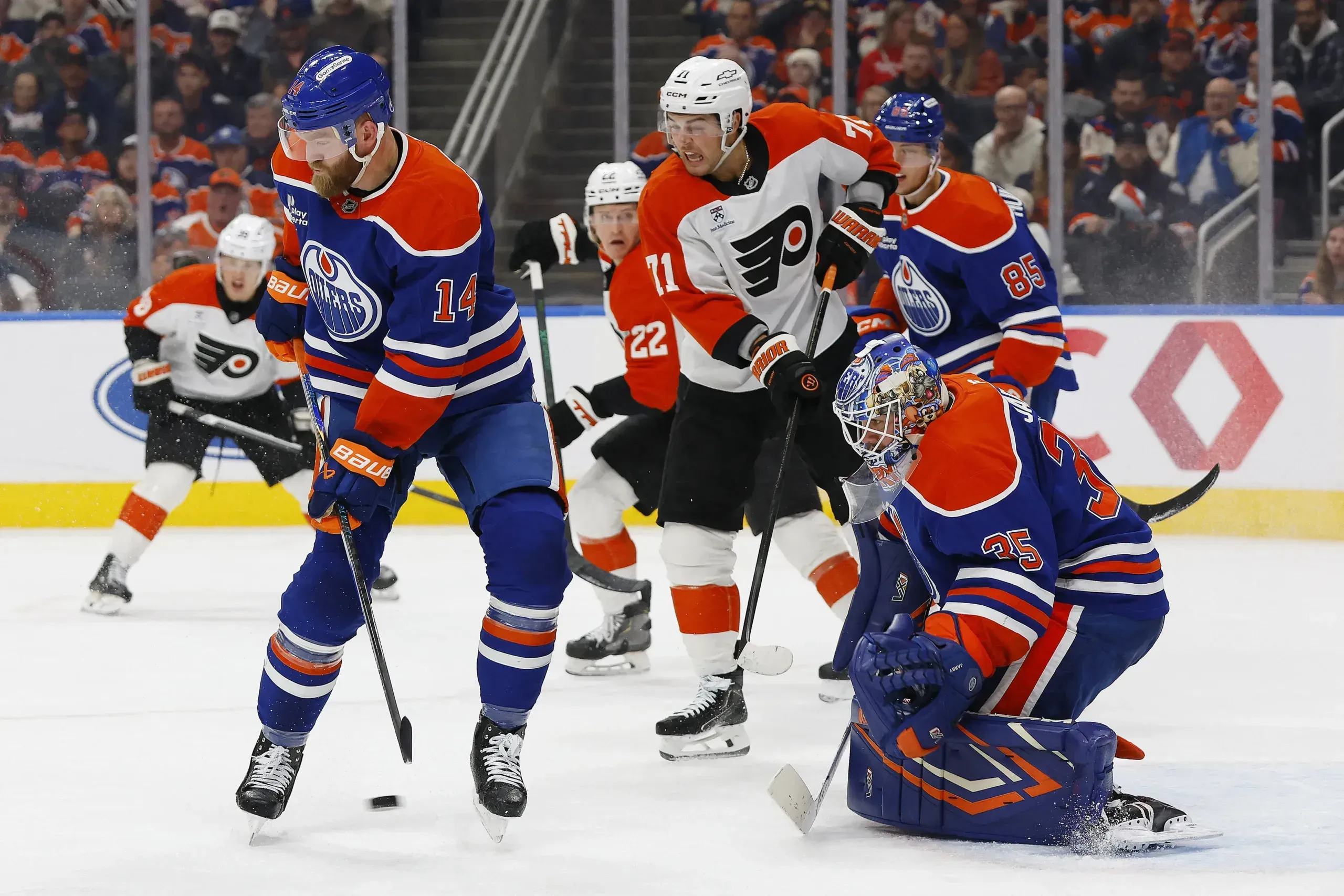
PHILADELPHIA — The Philadelphia Flyers showed plenty of fight against the Edmonton Oilers for the second time in five days, but another costly mistake ultimately overshadowed what could have been a momentum builder and ultimately ended up being a 5-2 loss in the first home game in nearly two weeks.
After falling behind 3-0 in the first period, the Flyers responded with a strong second period, scoring twice to cut Edmonton’s lead to one. The Flyers had momentum, was generating chances, and had a legitimate opportunity to erase the early deficit.
Then, just over a minute into the third period, Travis Konecny turned the puck over, leading to a Leon Draistail breakaway goal, restoring Edmonton’s two-goal lead.
The turnover took all of the life out of Flyers comeback attempt before it could even get started in the third period.
It was a frustrating sequence for a Flyers team that had worked hard to get back into the game. It was also one that Konecny immediately took responsibility for afterward.
“I take all the momentum from our team at the start of the third period there with the turnover,” Konecny said.
There was no attempt to deflect blame or minimize the significance of the mistake. Konecny understood what happened and what it cost his team.
“He feels bad, he knows he shouldn’t have done it. What are you gonna do?” Rick Tocchet said.
But the turnover wasn’t the only thing the veteran winger was holding himself accountable for. Konecny finished with a game-high six shots on goal but couldn’t find the back of the net despite several quality opportunities. The Flyers needed its offensive leaders to deliver in those moments, particularly after fighting its way back from a three-goal deficit. Konecny recognized that, too.
“I mean, self-evaluating right now, I don’t know how many looks I had. Way too many to not put one in,” he said.
It’s the kind of accountability the Flyers need from their leaders. Konecny wasn’t satisfied with simply generating opportunities. He understood that at some point, those chances have to translate into goals.
While Konecny took responsibility for his individual performance, head coach Rick Tocchet made it clear that the problem extends beyond one turnover or one player’s inability to finish. Tocchet acknowledged how difficult it is to give a team like Edmonton an early three-goal advantage, particularly with Connor McDavid and Draisaitl leading the way.
However, he also credited Philadelphia for its response and the opportunities it generated after falling behind.
“(I) think we had 29 chances. They had 14,” Tocchet said. “Like, I mean, I don’t know. It’s structure. It’s you got to finish, right?”
The Flyers created opportunities to make the comeback even more interesting, including several chances around the net that they couldn’t convert. But against an opponent with Edmonton’s offensive firepower, missed opportunities and costly mistakes can quickly become the difference.
Tocchet was particularly frustrated with the timing of the third-period turnover and the inability to avoid mistakes that put the team right back where it started.
“I mean, it’s a game of mistakes. It’s just you just got to make sure that there’s not a trend of them and it’s not the same guys. It’s you got to stop it, right? I don’t know. You just can’t make these kind of mistakes,” Tocchet said.
He also emphasized the importance of puck management against McDavid and Draisaitl. The Flyers had more success when they kept the puck low, forced Edmonton to defend and avoided putting the puck in dangerous areas through the middle of the ice.
When Philadelphia strayed from that approach, the Oilers made them pay.
Tocchet wasn’t interested in making excuses for the mistakes, even while acknowledging the effort it took to climb back into the game. There are positives to take from Konecny’s postgame comments. Having an established veteran openly acknowledge that he cost his team momentum and failed to capitalize on his opportunities is important.
There is also value in Tocchet holding his players responsible rather than overlooking mistakes because of a strong stretch of play.
But accountability cannot stop at the postgame podium.
The Flyers have to show that they are learning from these situations. They cannot continue putting themselves in difficult positions, fighting their way back into games, and then giving away momentum through preventable mistakes.
The same goes for their inability to finish. Generating chances is important, but eventually, they need their best offensive players to convert when opportunities present themselves.
Tocchet can identify the problems, and Konecny can own his mistakes, but the next step is making sure those mistakes don’t happen again.
There is a difference between accepting responsibility and actually holding yourself accountable. The former happens after the game. The latter has to show up in the next one.
For a Flyers team still searching for consistency, that distinction is becoming increasingly important.
